In your office
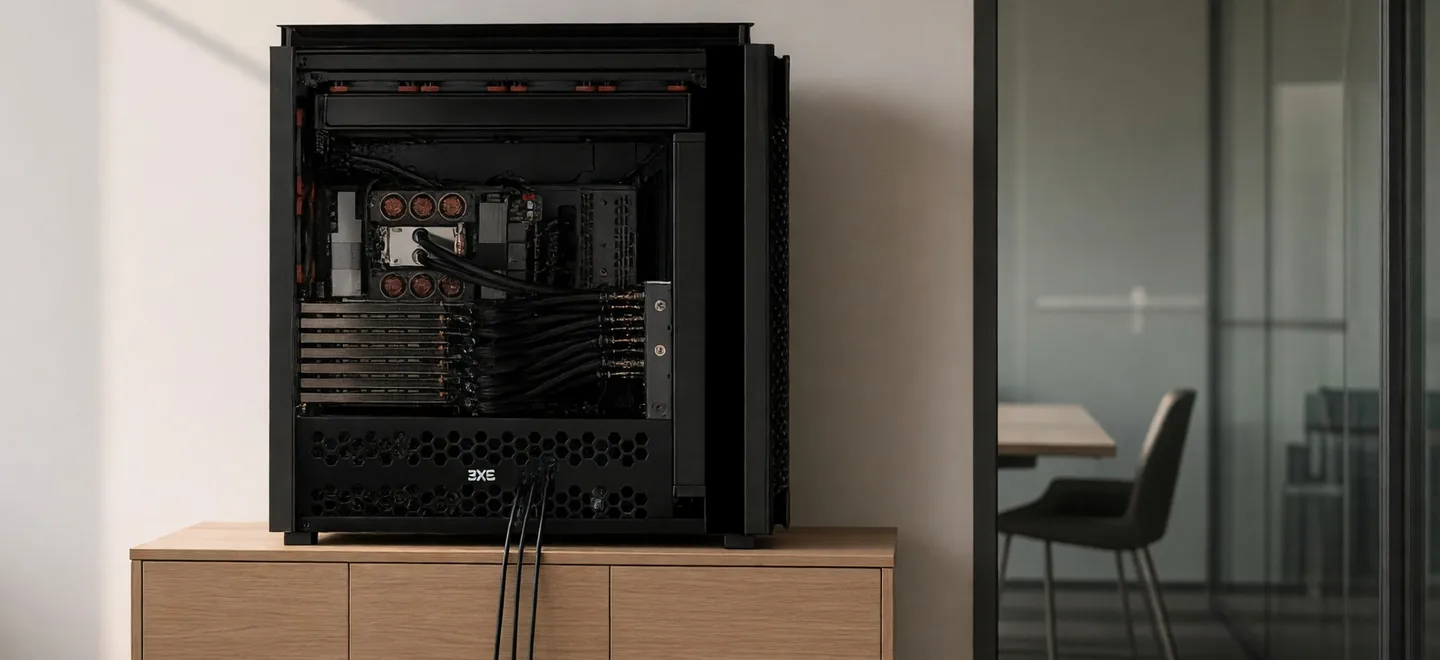
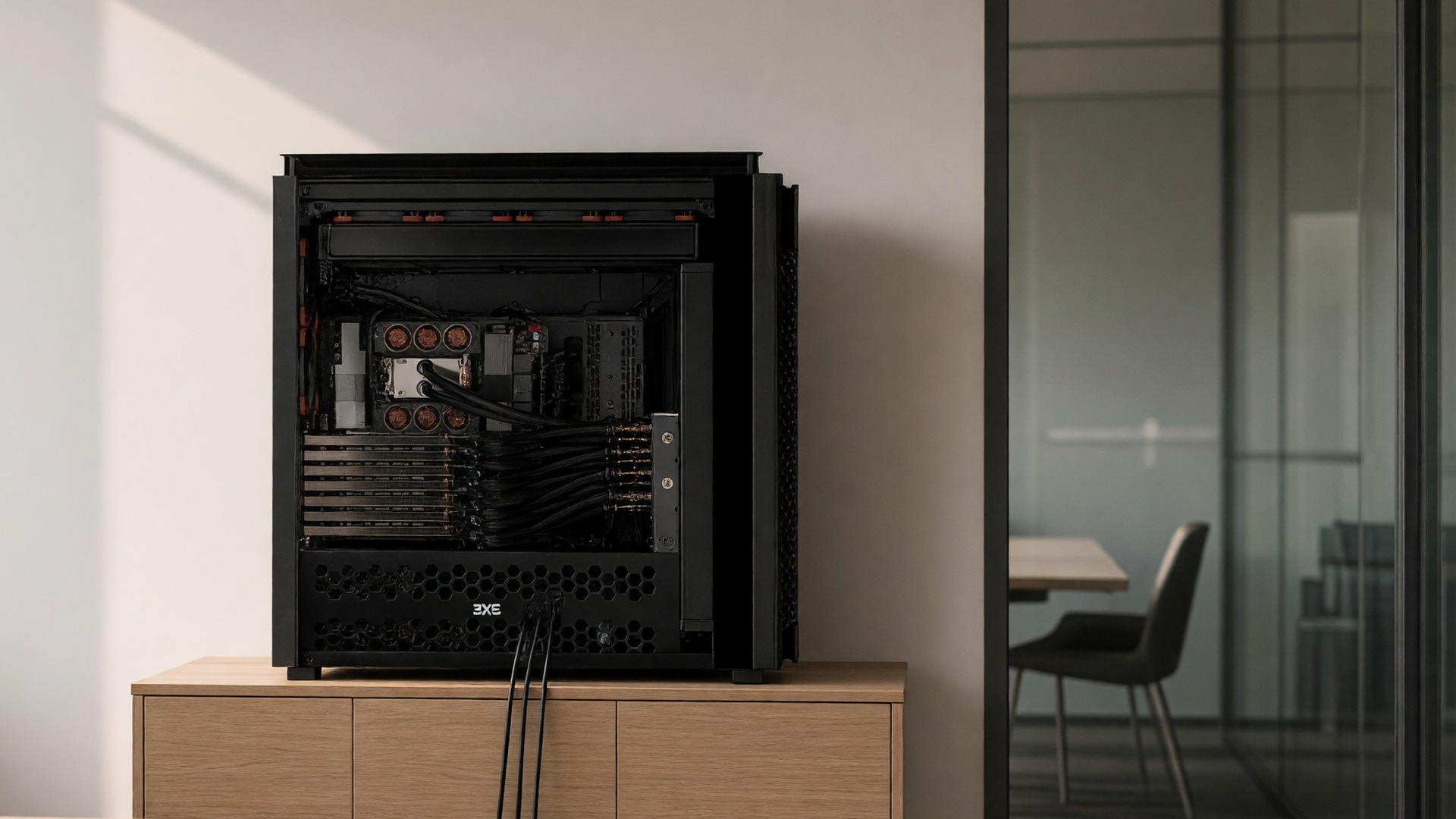
A server with GPUs on your network.

An AI that works like your team and gives your company a second brain that learns from everything that happens in it.

“It writes well, but it doesn't write like us.”
Drafts come out with the structure of the documents your team already uses.
The tone, the terms and the forms expected in your industry.
The steps and the criteria of each job, the way your company does it.
“I copy and paste between our system and the chat all day.”
Real screenshots · fictitious data
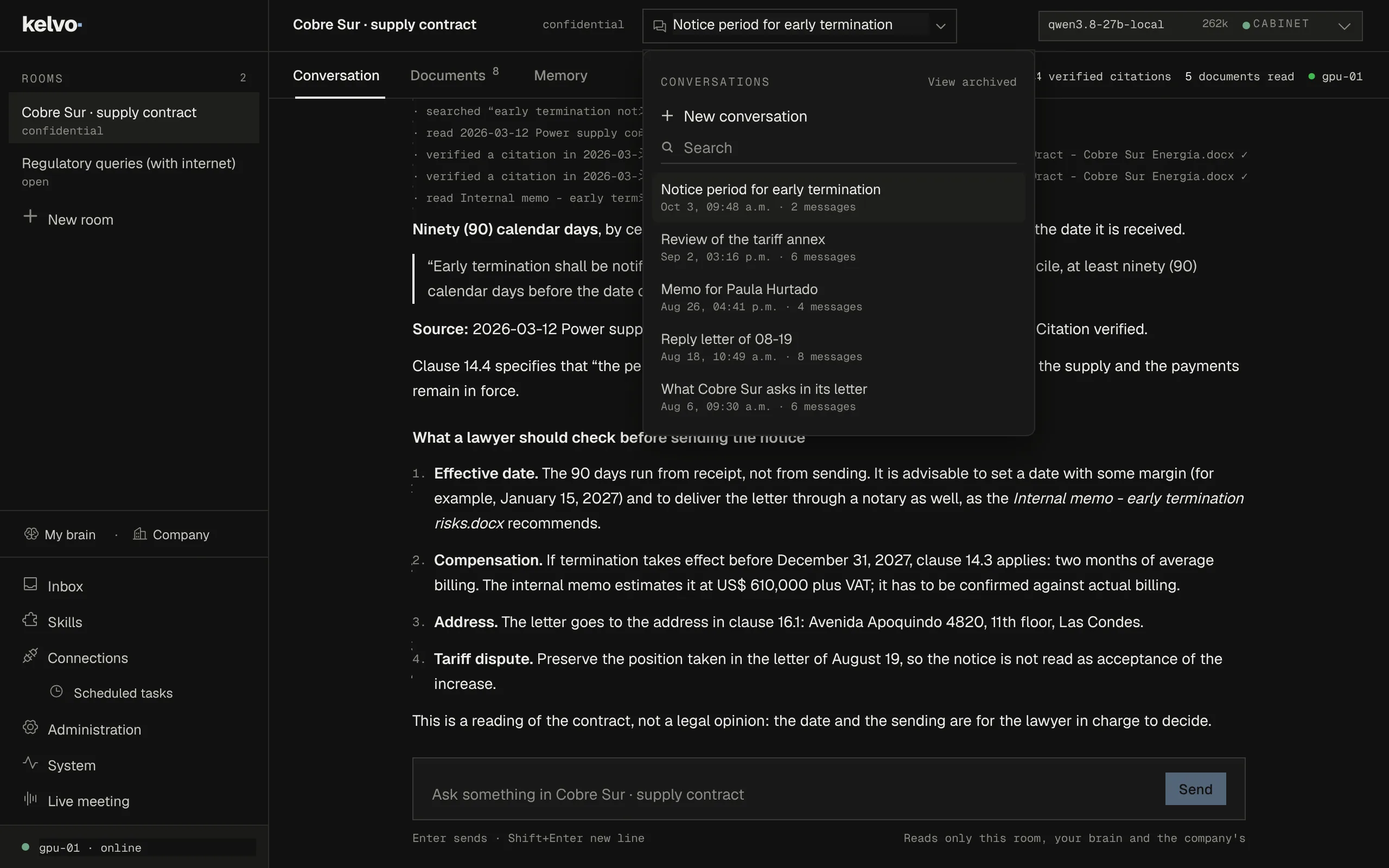
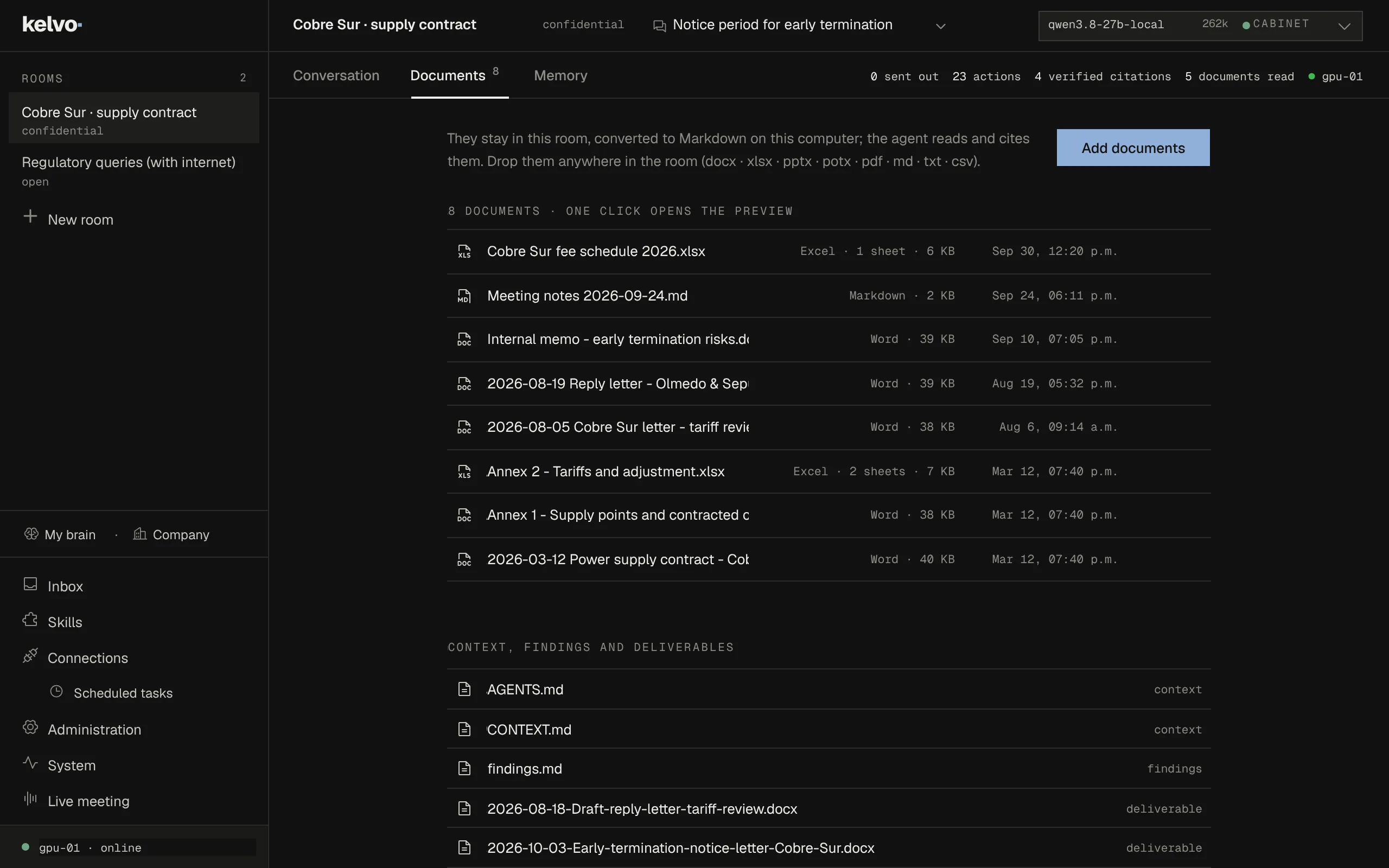
A room with its documents. Work with the documents on your own computer: nothing has to be uploaded anywhere.
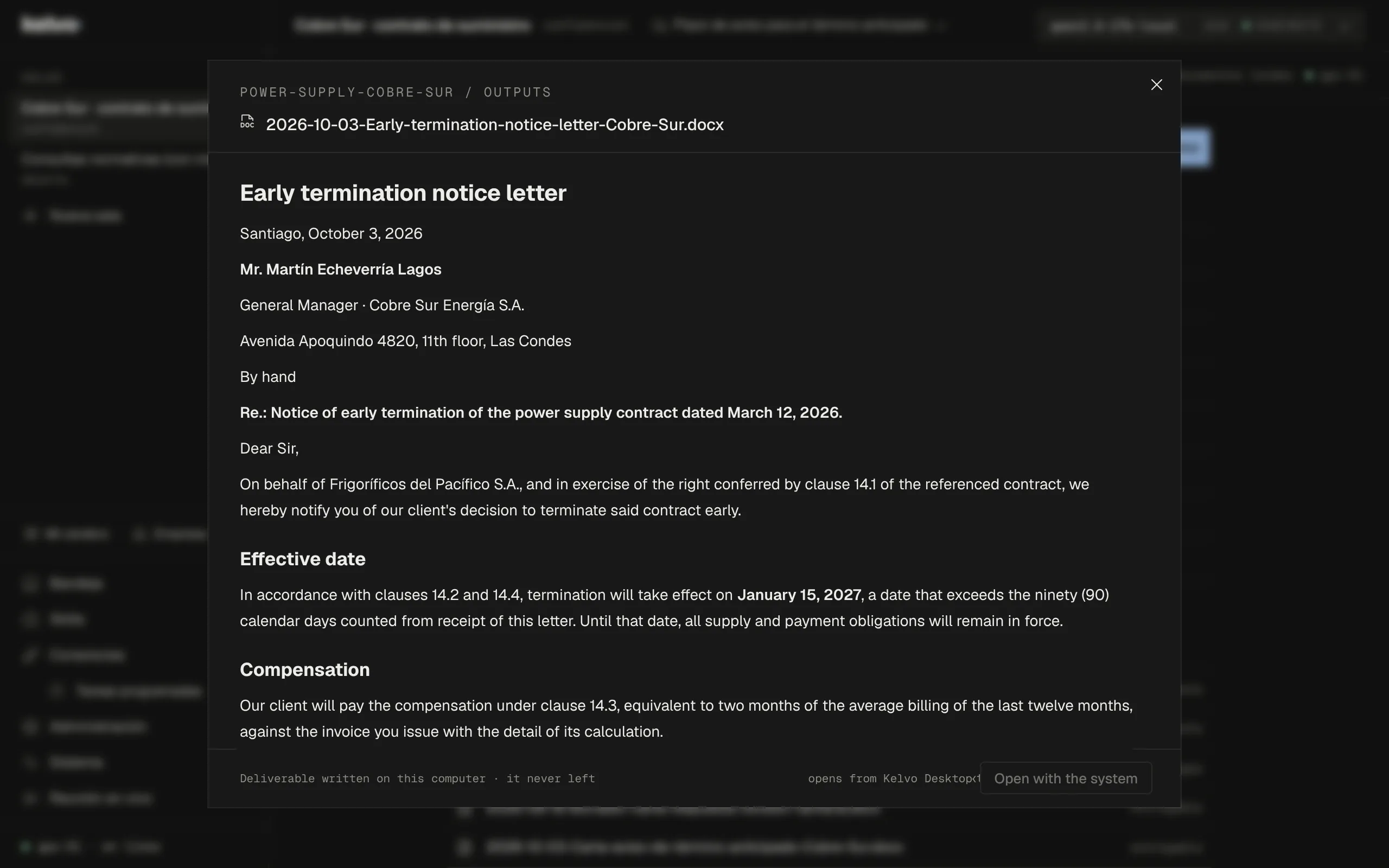
A finished deliverable. The work arrives as a Word, Excel or PowerPoint file, not as text to copy and paste.
“This contract is confidential. I can't upload it to any AI.”
The model, the memory and your documents live on your server, and it can search the web.
What was read, searched or written, in which room, and whether anything left the computer: it's all logged.
You don't pay per question or per document it reads.

“Every time someone leaves, we learn the same things all over again.”
It learns from everything that happens in your company.
With an outside provider, having them train on your data is a risk. With your own model, it's the advantage.
What is it?
Everything your team works on with Kelvo leaves something learned, and it stays on your server even after the person leaves.
Where does it learn from?
Meetings, documents and systems. From the web it brings what's new, like regulations and prices; what's yours never leaves.
What do you notice?
Drafts come out in your format, and newcomers ask it how things are done here.
How does it learn?
From day one it consults what it has learned. Over time the model is fine-tuned and knows it without looking it up.
Does it work when nobody asks?
With your own compute, that's part of the fixed cost, not a charge for every document it reads.
Who decides?
Nothing enters the company's memory without approval, and each matter sees only its own.

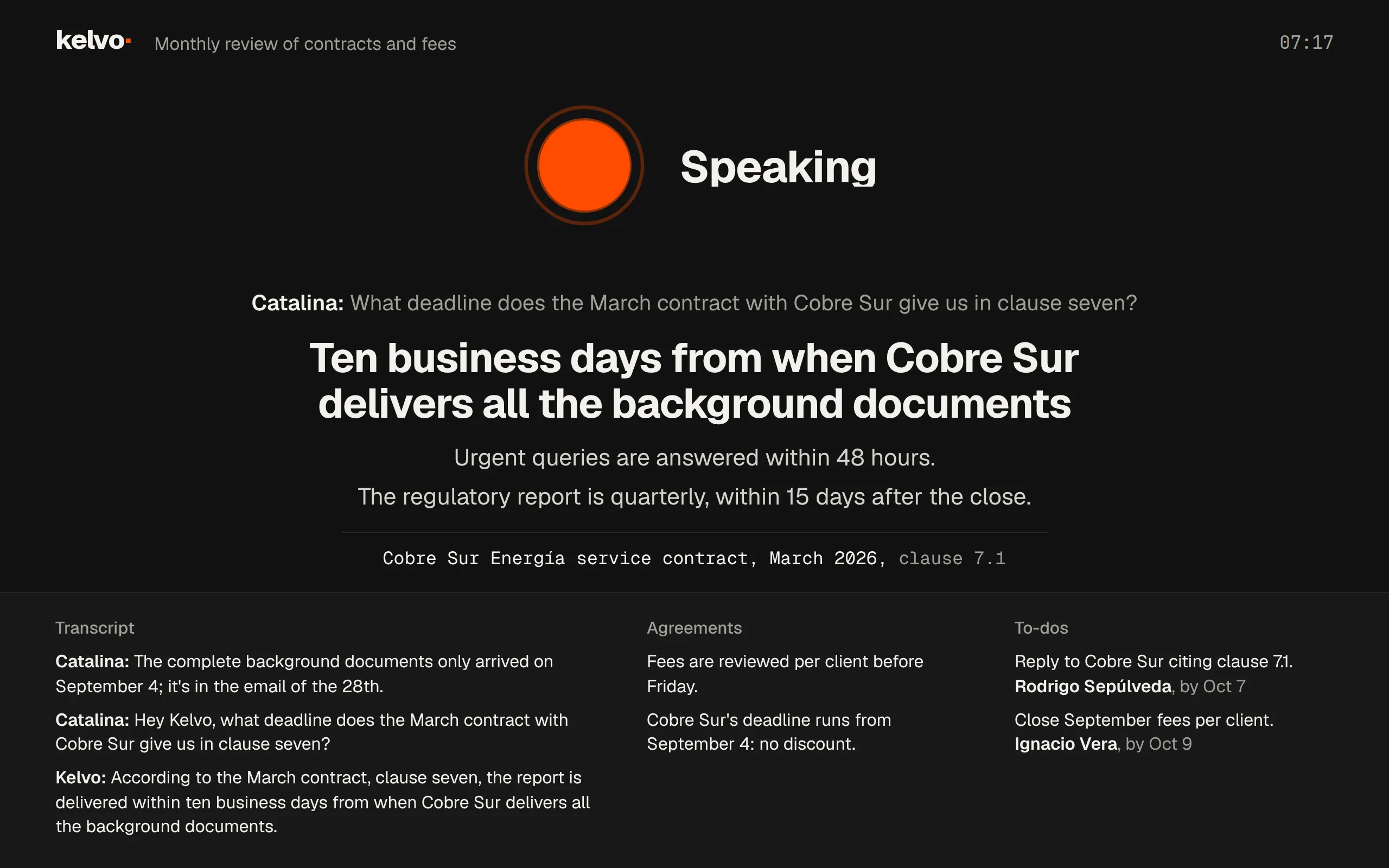
“In the meeting, nobody remembers what the contract said.”
“What did we agree last meeting?”, and it answers with the minutes as its source.
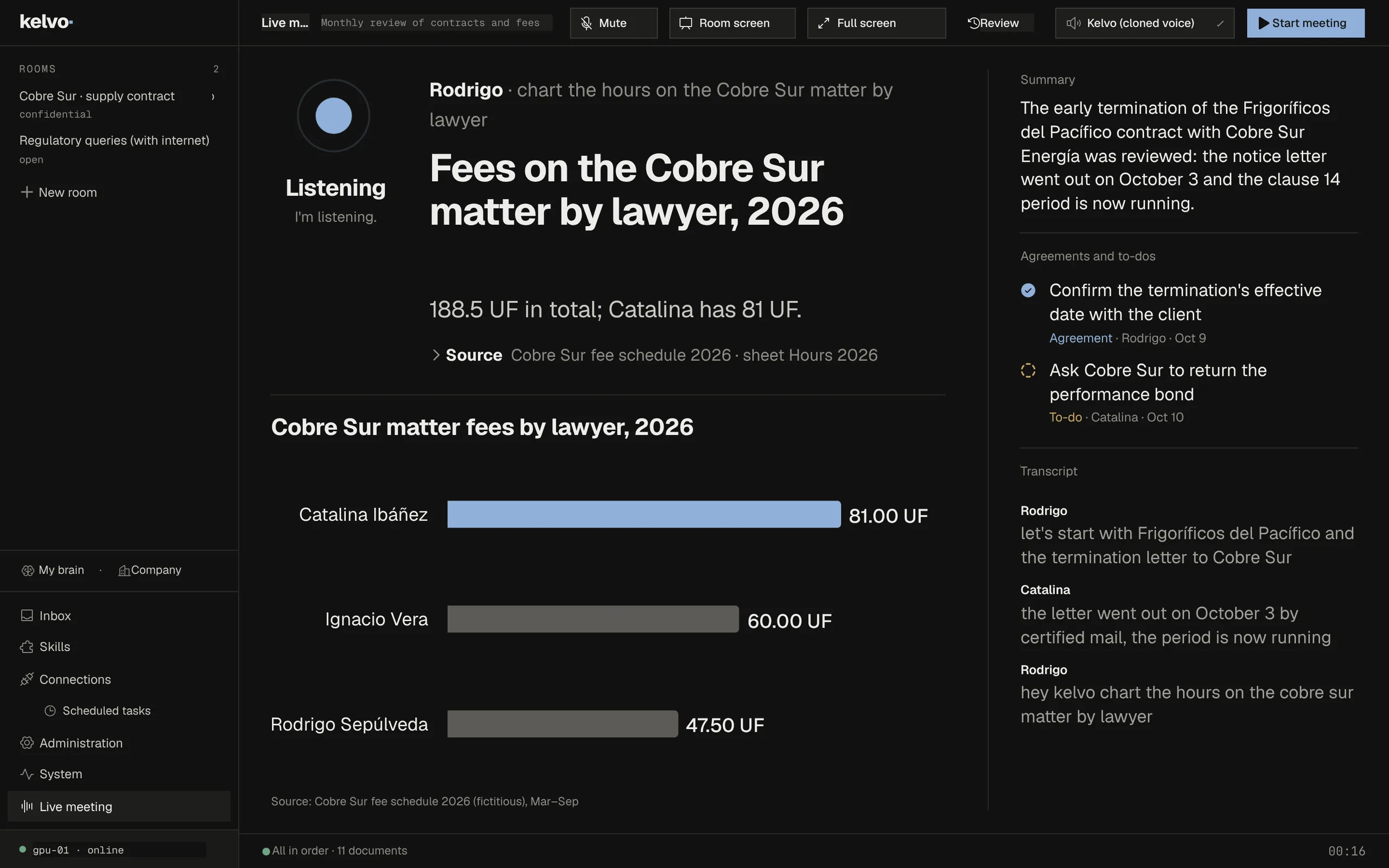
“Chart the hours on this matter by lawyer”, and the chart appears right away.
It steps in when someone says something a document contradicts.
Each with its owner, and everything stays in the company's memory.
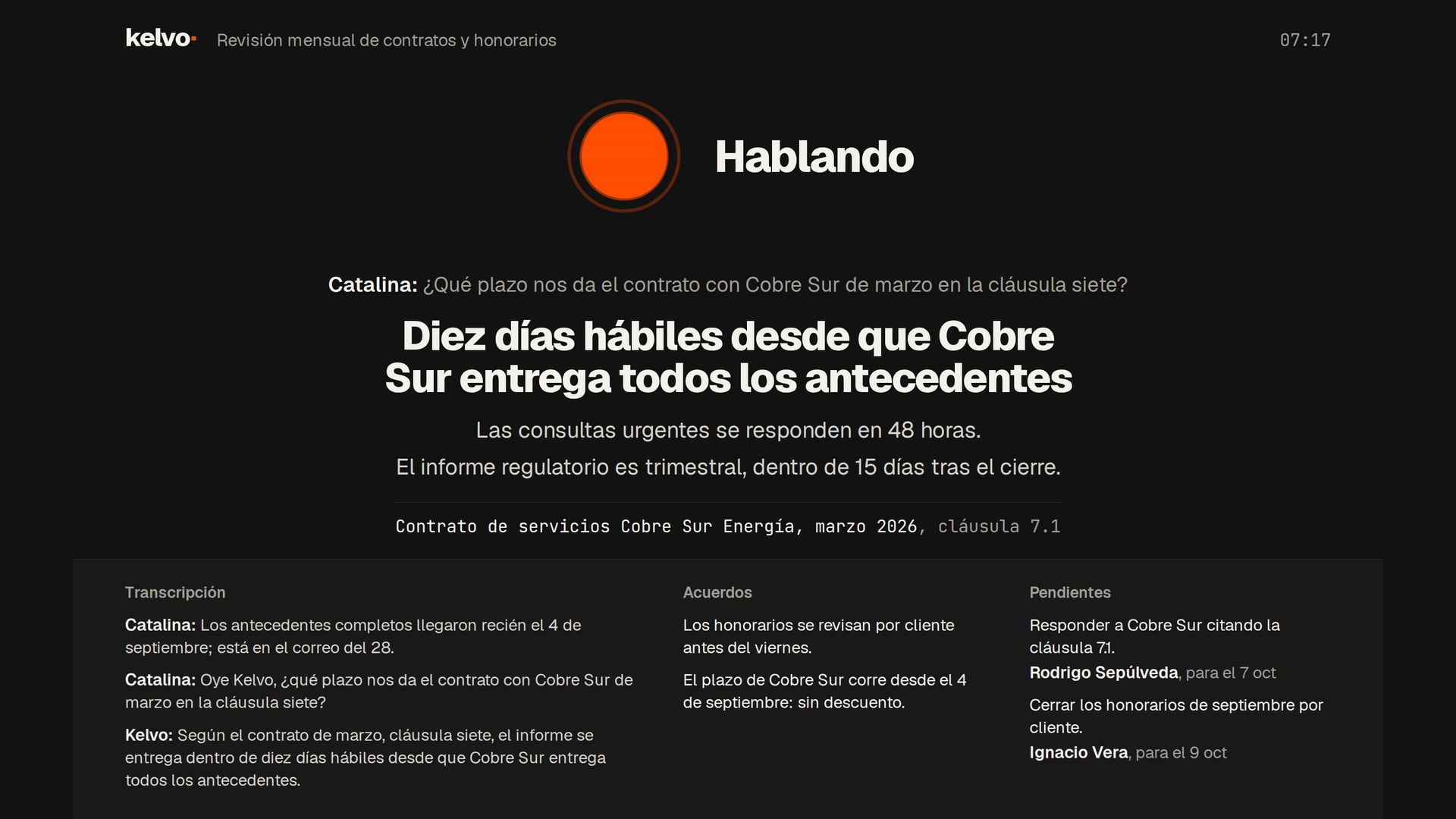
Real screenshots · fictitious data
In Spanish, 1:28.
Contracts and filings with the firm's own judgment.
What risks does this agreement carry against our standard?
Talk to your operating data without it leaving the plant.
What happened with boiler 2 on August 14 between 03:00 and 05:00?
Reconciliations and tenders with information that never leaves.
Match these invoices against the bank statement and flag the differences.
Your own compute for research: the same server serves administration and the projects.
Train the model on the lab's corpus and keep a record of every run.
Illustrative examples. Names, data and matters are fictitious.
A server with GPUs on your network.
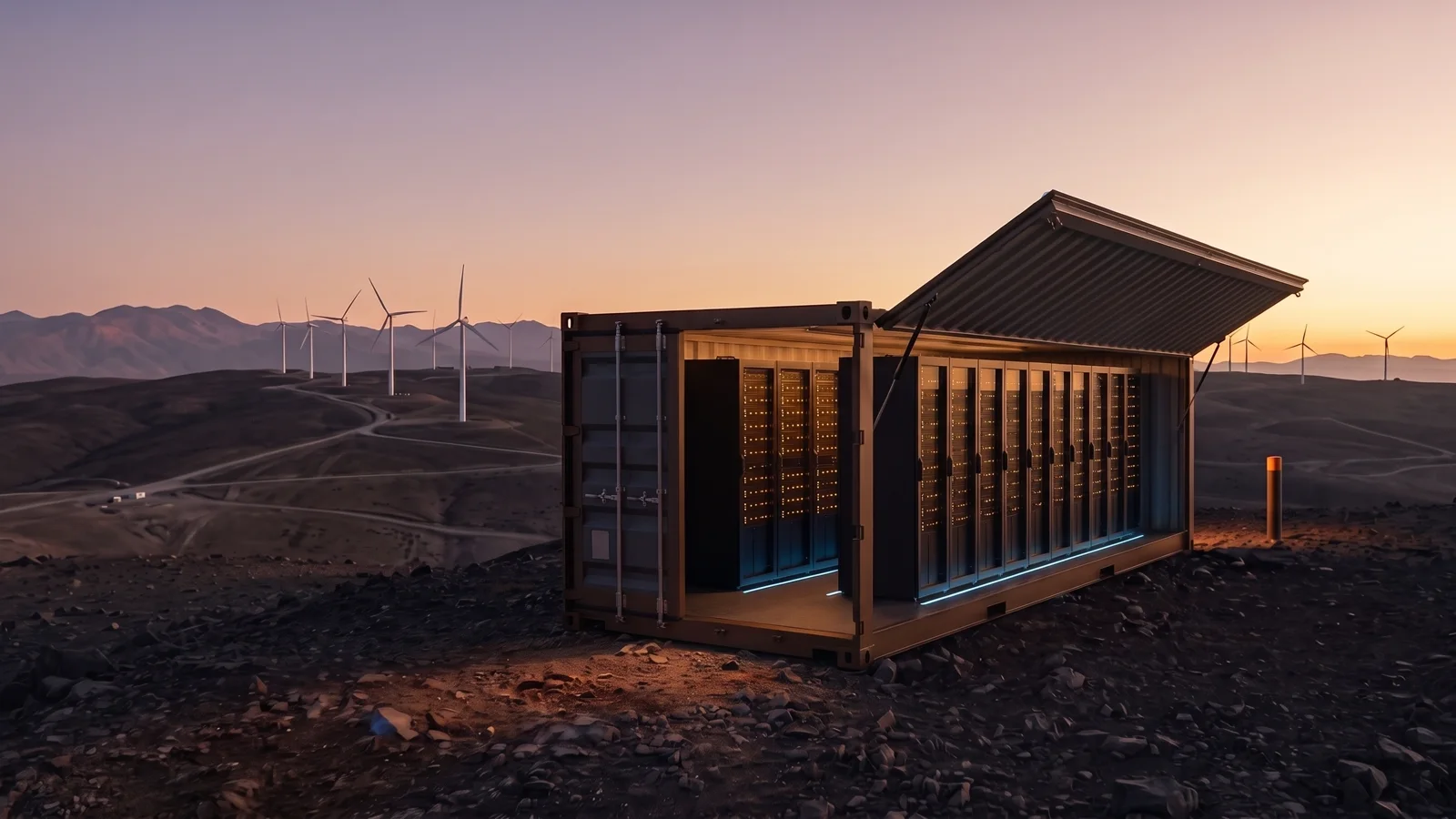
A container with GPUs reserved for your company, at a site operated by Kelvo. No server in your office.
The same product in two places; in both, we operate it.
Learn about the server →
Antonio Marinovic
CEO
MBA, Babson College. Lawyer, Universidad de los Andes. Experience in M&A transactions and bond financing.

Diego Mir Bezanilla
CTO
Industrial engineer, Pontificia Universidad Católica de Chile, with a diploma in computer science.

Alejandro Bañados
COO
Industrial engineer, Pontificia Universidad Católica de Chile, with experience in energy and AI in production.
Both protect your data, but in different ways. With the agreement, your data travels to the provider's servers and the provider commits not to use it to train its models. With Kelvo, your data doesn't leave: the model, the memory and the documents are on a server that is yours or reserved for you, and every action goes into a log you can review.
The other difference is what happens with what your company teaches. With the agreement, none of it stays in any model: the next day the AI knows as much about you as it did on day one. With Kelvo, what your team approves is used to fine-tune a model that belongs to your company.
The best open models are very close to the best closed ones. In the most widely used public comparison, the gap between the best on each side is 3.3 % (Stanford AI Index, 2026), and on some tests an open model has already beaten the closed ones of its day. The most capable ones are very large and need a lot of compute, and for much of a company's work a smaller one is enough. That's why what matters is choosing the right one for each case: we measure it on your own tasks before recommending one.
On top of that, the chosen model is fine-tuned to your company. Fine-tuning means training it a little further on what your team approves, so it learns your way of working: the structure, the tone and the criteria. That's how it writes like you without being told every time. With closed models this is less and less possible: the big providers are closing it off or limiting it.
Because they do different things, and Kelvo does both.
What you notice day to day: drafts that come out the way your team would write them, fewer corrections and the same way of working across every case. We start from open models and fine-tune them with LoRA, which trains a small layer on top of the model, on your own server, with what your team approves over time. Kelvo stores that from the start in a format that is ready for fine-tuning.
Since your data is already organized for fine-tuning, the new model is fine-tuned on that same data and tested against the one you have, in two ways: with our test bench, which runs real work cases and saves what each model produces so it can be reviewed, and with your own team, which compares answers from both without knowing which is which and picks the one it prefers.
If the new one wins on both, we propose switching, and we switch only if you approve. In the meantime, the version your team validated doesn't change on its own. That way your AI improves along with the open models, without depending on anyone's terms.
The model, the memory and the documents are on a server that is yours or reserved for you. That doesn't mean working offline: your team's computers connect to the server over the office network or through a private, encrypted connection. What doesn't exist is an open door from the internet into the server.
When the AI searches the web, the only thing that goes out is the query, without your data. Every read, search and written file is logged with the room, the time and whether anything left.
You decide what the whole company knows and what only one group knows:
No. Many of these platforms run on models from different AI providers under the hood. We can be one more: we offer your platform our compute and our models, your team keeps using it as before, and the same compute is available to your company.
It can also work the other way around: the platform plugs into Kelvo, and your team works in our system with the platform's skills and industry knowledge.
The law updates personal data protection in Chile. Using AI on servers abroad is lawful with the standard contractual clauses, but it adds an international transfer and more compliance reviews. Processing on your own server avoids that transfer.
In addition, people can ask you for access to their data, to correct it, delete it or take it with them, and you have a deadline in business days to respond. Since in Kelvo the information is organized by room and searchable, it's easier to find and hand over what you hold on someone.
Running locally doesn't exempt you from the rest: the legal basis and the impact assessment are still yours. There is a bill to move the law's effective date to December 1, 2027, so it's worth confirming it when you decide.
It depends on the size of the team and the tasks, and we work it out in the assessment. After that the cost is fixed: you don't pay per question, per document it reads or per fine-tuning run.
Tell us what your team does and what you'd like to solve with AI. We'll show you Kelvo Desktop with a case from your industry. We reply within 48 business hours.